Sacred Geometry Shapes: The Meaning of Circles, Triangles, and the Blueprint of Reality Part 2 of the Sacred Geometry Series
Explore the meaning of sacred geometry shapes and discover how circles, triangles, and lines form the foundational patterns of reality. In this second part of the Sacred Geometry Series, we move beyond the idea of geometry as abstract design and begin to understand the deeper language of form—how simple shapes repeat across nature, structure, and perception to create everything we experience. Sacred geometry shapes appear in the orbit of planets, the structure of cells, the branching of trees, and the patterns of growth found throughout the natural world. These forms are not random—they are efficient, stable, and deeply embedded in the way systems organize themselves. The circle represents unity, continuity, and infinite cycles. The triangle introduces structure, balance, and the tension required for creation. The line reflects movement, direction, and the pathways through which energy flows. Together, these shapes act as the building blocks of more complex geometric systems, including the Flower of Life, Metatron’s Cube, and other sacred geometry patterns found in both nature and human design. By understanding these foundational forms, we begin to see how complexity emerges from simplicity and how patterns repeat across different scales of existence. This article explores the symbolic meaning of sacred geometry shapes, their presence in nature, and their influence on art, design, and human perception. It also examines why these patterns feel familiar and meaningful—how the human mind is wired to recognize structure, balance, and repetition, and why these shapes resonate on both a visual and intuitive level. Whether you are interested in spiritual symbolism, geometric design, or the hidden patterns that shape the world around us, this guide offers a deeper look into the language of sacred geometry and the role these simple forms play in the architecture of reality.
SACRED GEOMETRY & ARTSPIRITUAL SYMBOLISMNUMEROLOGYSELF DISCOVERY
Serenity
5/2/20265 min read
Part 2 of the Sacred Geometry Series
In the first part of this series, we explored sacred geometry as a hidden architecture—an underlying pattern woven into nature, perception, and existence itself.
But patterns do not begin as complexity.
They begin as simplicity.
Before there are intricate forms, sacred diagrams, or layered symbolic systems, there are shapes—quiet, repeating, foundational structures that appear again and again across every scale of reality.
The circle.
The triangle.
The line.
These are not merely visual tools used in art or mathematics. They are the earliest expressions of order—structures that arise wherever energy stabilizes, wherever motion becomes form, wherever something begins to take shape instead of remaining undefined.
To understand sacred geometry is not to memorize symbols. It is to recognize that beneath everything complex lies something profoundly simple—something that repeats because it works.
These shapes are the language of that repetition.
What Are Sacred Geometry Shapes?
Sacred geometry shapes are the most fundamental geometric forms that appear consistently across nature, mathematics, architecture, art, and systems of symbolic meaning.
They are called “sacred” not because they originate from mysticism, but because they are persistent—they show up regardless of culture, belief system, or era. They exist in places that could not have influenced one another, suggesting that they are not inventions, but discoveries.
You find them:
in the orbit of planets
in the structure of atoms
in the branching of trees
in the proportions of the human body
in the growth patterns of shells and flowers
These shapes are not decorative. They are functional.
They appear wherever systems organize themselves efficiently, wherever forces balance, wherever movement resolves into stability.
And because they are so deeply embedded in how reality organizes itself, they begin to carry meaning—not assigned meaning, but inherent meaning, derived from how they behave.
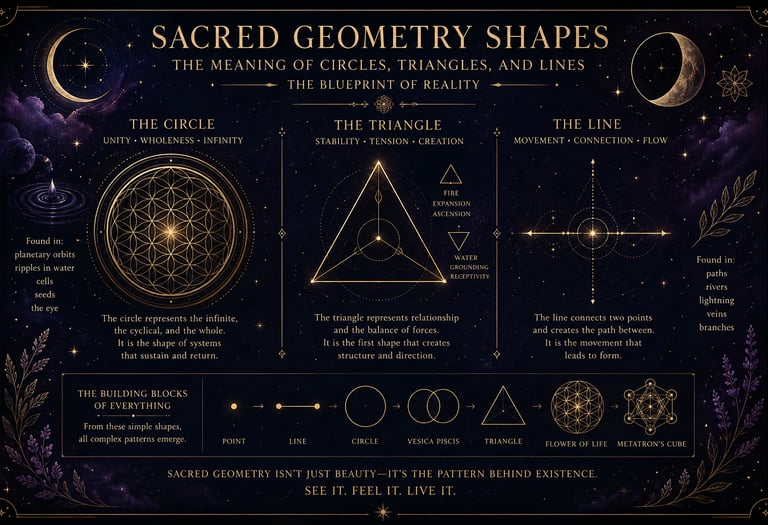
The Circle: Unity, Wholeness, and the Infinite Loop
The circle is the most complete and self-contained form in sacred geometry.
It has no beginning and no end.
No hierarchy.
No interruption.
It is continuous.
In a circle, every point is equidistant from the center. This creates a structure that is perfectly balanced—no part is more important than another. It is a system in equilibrium.
In nature, circles appear wherever motion stabilizes into repetition:
planetary orbits
ripples expanding across water
the cross-section of cells
the iris and pupil of the eye
seeds, fruits, and microscopic structures
The circle is what happens when something sustains itself.
Symbolically, it has come to represent:
unity
wholeness
infinity
cycles and recurrence
protection and containment
But beyond symbolism, the circle reflects a deeper principle:
Closed systems conserve energy.
A circle does not leak. It does not break. It loops.
This is why circles often appear in systems that must maintain themselves—whether biological, planetary, or conceptual.
Psychologically, the circle resonates because we recognize it as completion. It is the shape of things that are resolved, contained, or returning to themselves.
When something is circular, it is not unfinished. It is ongoing.
The Center: The Hidden Anchor of the Circle
A circle cannot exist without a center.
Though invisible, the center defines everything about the shape. It is the reference point from which all distances are measured. It is stillness inside motion.
In many symbolic systems, the center represents:
awareness
origin
the point of perception
stillness within change
This is not arbitrary.
Every rotating system requires a stable axis. Every orbit implies a center of gravity. Every cycle emerges from a fixed point, even if that point cannot be seen directly.
The circle teaches us something subtle:
Movement depends on stillness.
The Triangle: Structure, Tension, and the Emergence of Form
If the circle represents unity, the triangle represents structure.
It is the simplest shape that can create a stable plane. With two points, you have a line—unstable, directional, unresolved. With three points, you have form.
The triangle introduces:
direction
hierarchy
tension
orientation
It is the first shape that can hold itself in space.
In architecture, triangles distribute force. In engineering, they are used to create frameworks that do not collapse. In nature, triangular structures appear where stability is required under pressure.
Symbolically, the triangle has been associated with:
balance between forces
transformation
creation through interaction
Upward-pointing triangles are often linked to expansion, ascent, and outward movement.
Downward-pointing triangles are associated with grounding, containment, and inward movement.
But more fundamentally, the triangle represents something deeper:
Relationship creates reality.
Three points define a system.
Three points create tension.
Tension allows form to exist.
Without tension, there is no differentiation. Without differentiation, there is no structure.
The Triangle as Process: Beginning, Middle, End
The triangle also mirrors how processes unfold.
Every event has:
a beginning
a middle
an end
Every system has:
input
transformation
output
Every perception involves:
observer
observation
observed
The triangle is not just a shape—it is a pattern of interaction.
This is why it appears in storytelling, in logic, in physics, and in symbolic systems. It reflects a structure that repeats across domains.
The Line: Movement Before Form
Before the circle stabilizes and before the triangle defines space, there is the line.
A line is movement.
It connects two points, implying direction, transition, and flow. It is not yet a structure—it is the possibility of one.
In sacred geometry, the line represents:
motion
connection
trajectory
the path between states
Lines are how energy travels before it settles into pattern.
In natural systems, lines appear as:
growth directions in plants
paths of least resistance
currents and flows
neural pathways
fault lines and branching structures
Where the circle contains and the triangle stabilizes, the line explores.
It is the beginning of complexity.
From Line to Shape: How Complexity Emerges
When lines repeat, they create grids.
When lines intersect, they create nodes.
When lines curve, they create circles.
When lines connect in threes, they create triangles.
Complexity is not separate from simplicity—it is built from it.
Every intricate sacred geometry pattern can be broken down into:
lines
circles
triangles
These are the building blocks.
From them emerge:
the Vesica Piscis (intersection of circles)
the Flower of Life (repeating circular pattern)
Metatron’s Cube (network of interconnected lines and nodes)
crystalline lattices
natural growth systems
What appears intricate is often just repetition applied over time.
Sacred Geometry in Nature: Where These Shapes Appear
These shapes are not confined to diagrams or symbolic art—they are embedded in the physical world.
Circles appear in:
planets
droplets
biological cells
Triangles appear in:
mountain formations
structural frameworks
crystalline structures
Lines appear in:
branches
veins
rivers
lightning
Even spirals—which we will explore later—are built from circular motion extended through space.
Nature does not randomly generate form. It organizes around efficiency, balance, and stability.
Sacred geometry shapes are simply the most effective ways for systems to exist.
Why These Shapes Feel Familiar
There is a reason these forms feel intuitive—even when you have never studied them.
Your brain is designed to recognize patterns.
Your body is composed of structured systems.
Your environment is shaped by repeating forms.
So when you encounter these shapes, you are not learning something new.
You are remembering something fundamental.
The recognition is not intellectual—it is perceptual.
You feel it before you analyze it.
Sacred Geometry in Design and Human Perception
Designers—whether consciously or not—use these shapes to create harmony.
Balanced logos often rely on circular symmetry.
Stable compositions use triangular arrangements.
Movement and flow are guided by lines.
When a design “feels right,” it is often because it aligns with geometric principles your brain already understands.
This is why sacred geometry appears in:
branding
architecture
art
product design
Not because it is mystical—but because it is effective.
It resonates.
The Emotional Response to Geometry
Certain shapes evoke specific responses:
circles feel safe, complete, and continuous
triangles feel dynamic, directional, and purposeful
lines feel active, transitional, and unresolved
These responses are not arbitrary.
They are rooted in how these shapes behave in real systems.
Your perception is not separate from reality—it is shaped by it.
Bringing These Shapes Into Everyday Life
Sacred geometry is not limited to study or theory.
It can be integrated into:
objects
spaces
visual environments
personal items
When these shapes are used intentionally, they create a sense of cohesion—something that feels aligned, even if it cannot be immediately explained.
This is why people are drawn to geometric patterns in:
jewelry
artwork
design pieces
everyday objects
They are not just visually appealing.
They are structurally meaningful.
A Quiet Realization
If these shapes appear everywhere—in nature, in design, in perception—then they are not separate from you.
They are part of the system you exist within.
And understanding them is not about learning something external.
It is about recognizing patterns that have always been present.
Continue the Series
In the next part of this series, we move from individual shapes into a pattern built from their repetition:
The Flower of Life—a structure that expands from simple circles into one of the most recognizable patterns in sacred geometry.
It is where simplicity begins to multiply.
And where the blueprint becomes visible.